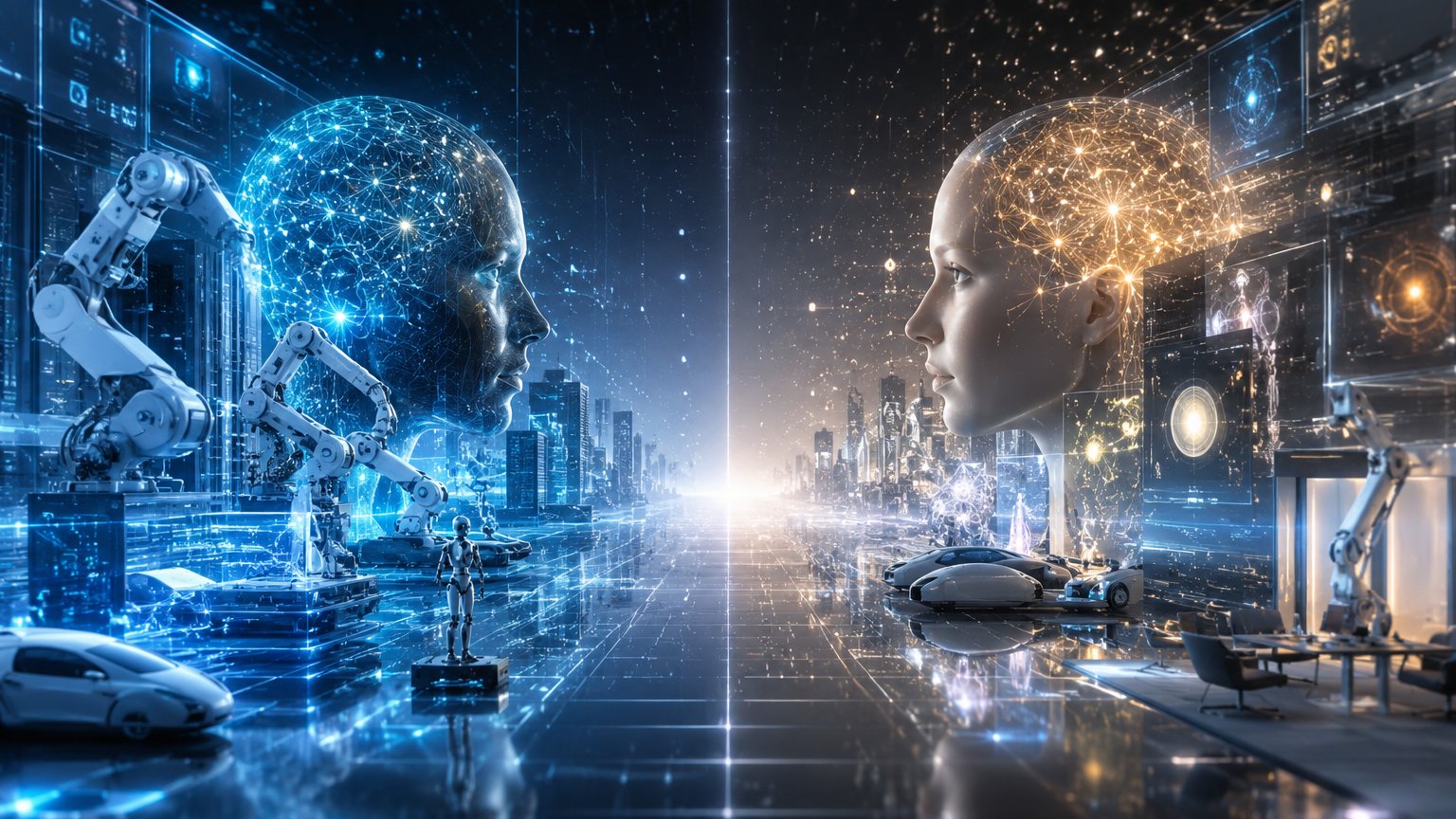
The Next Great Leap in Intelligence
Artificial intelligence has rapidly evolved from a futuristic concept into a technology that shapes our everyday lives. Whether you are using a virtual assistant, receiving personalized recommendations on a streaming platform, navigating with GPS, or interacting with a customer service chatbot, AI is already working behind the scenes. Yet despite its impressive capabilities, the AI we use today is only one part of a much larger conversation. Increasingly, technology experts, researchers, and futurists are discussing a more advanced concept known as Artificial General Intelligence, or AGI. While AI is already transforming industries and economies, AGI represents a potential future where machines possess the ability to think, reason, learn, and adapt across virtually any task a human can perform. The distinction between AI and AGI is one of the most important topics in modern technology. Understanding the differences can help businesses, educators, policymakers, and everyday consumers prepare for a future that may be dramatically different from the world we know today.
A: No, it is a powerful AI system but not AGI.
A: No verified AGI system currently exists.
A: Current AI imitates reasoning but lacks human cognition.
A: Broad adaptability across virtually all tasks.
A: It may automate some roles while creating others.
A: Potential risks depend on design and governance.
A: Ensuring advanced systems act according to human values.
A: Many researchers believe it could accelerate discoveries.
A: Some theorize Artificial Superintelligence (ASI).
A: It could become the most transformative technology ever created.
What Is Artificial Intelligence?
Artificial Intelligence refers to computer systems designed to perform tasks that typically require human intelligence. These tasks may include recognizing images, understanding language, analyzing data, making predictions, or solving specific problems.
The vast majority of AI systems in existence today fall into a category known as Narrow AI. Narrow AI excels at particular tasks but cannot operate outside of its programmed or trained domain. A chess-playing AI may defeat world champions, but it cannot drive a car. A language model may generate impressive written content, but it cannot independently perform surgery.
Modern AI systems rely heavily on machine learning, deep learning, neural networks, and large datasets. By analyzing enormous amounts of information, these systems identify patterns and make decisions based on learned relationships.
Examples of AI include:
Voice assistants such as Siri and Alexa, recommendation algorithms used by Netflix and Spotify, facial recognition systems, autonomous driving technologies, fraud detection systems, and advanced language models.
Although these systems often appear intelligent, they do not truly understand the world in the same way humans do. They are highly specialized tools designed for specific purposes.
What Is Artificial General Intelligence?
Artificial General Intelligence represents a theoretical form of machine intelligence capable of understanding, learning, and applying knowledge across a wide range of tasks at a human or even superhuman level.
Unlike narrow AI, AGI would not be limited to a single function or domain. An AGI system could potentially learn mathematics, write novels, conduct scientific research, compose music, diagnose diseases, and solve entirely new problems without needing separate training systems for each task.
In essence, AGI would possess a flexible intelligence similar to that of humans. It could transfer knowledge from one area to another, adapt to unfamiliar situations, and develop solutions to problems it has never encountered before.
While AI systems can perform remarkable feats, AGI aims to replicate the broad cognitive abilities that define human intelligence itself.
At present, true AGI does not exist. It remains one of the most ambitious goals in computer science and artificial intelligence research.
The Core Difference Between AI and AGI
The most significant difference between AI and AGI lies in scope and adaptability.
Artificial Intelligence is specialized. It performs specific tasks exceptionally well but struggles outside those boundaries.
Artificial General Intelligence is generalized. It would be capable of learning and adapting to virtually any intellectual challenge.
Imagine hiring a specialist who is the world’s greatest accountant but cannot cook, drive, or speak another language. That specialist resembles today’s AI.
Now imagine hiring someone who can learn any skill, solve diverse problems, and continuously adapt to new situations. That individual resembles the concept of AGI.
This distinction may seem simple, but it represents one of the largest technological gaps humanity has ever attempted to bridge.
How Current AI Systems Work
Modern AI systems rely on extensive training using data.
A language model learns from billions of words. An image recognition system learns from millions of pictures. A recommendation engine learns from user behavior and preferences.
The process involves identifying patterns within data and using those patterns to make predictions or decisions.
While this approach can produce extraordinary results, it also creates limitations. AI systems often struggle with common sense reasoning, contextual understanding, and situations that differ significantly from their training data.
For example, an AI trained to identify cats and dogs may perform poorly when shown an entirely unfamiliar animal. Similarly, a chatbot may generate convincing responses without genuinely understanding the meaning behind the conversation.
These limitations highlight why current AI systems are not considered AGI.
How AGI Would Be Different
AGI would go far beyond pattern recognition.
A true AGI system would possess the ability to reason, understand abstract concepts, plan long-term strategies, and learn independently across multiple domains.
Instead of requiring separate training for every new task, AGI could transfer knowledge from one field to another. It could use lessons learned in science to solve engineering problems or apply mathematical reasoning to social challenges.
This flexibility mirrors one of the defining characteristics of human intelligence. Humans continuously learn from experience and adapt to unfamiliar situations. AGI seeks to replicate this capability in machines.
If achieved, AGI could potentially perform almost any cognitive task better, faster, and more consistently than humans.
Real-World Examples of AI
Artificial Intelligence is already deeply integrated into modern society.
Healthcare providers use AI to analyze medical images and assist with diagnoses. Financial institutions employ AI to detect fraud and assess risk. Retailers use recommendation systems to personalize shopping experiences.
Autonomous vehicles rely on AI to interpret road conditions and make driving decisions. Manufacturing facilities use AI-powered robots to improve efficiency and reduce errors.
Even creative fields are experiencing AI-driven transformation. Artists, writers, musicians, and designers increasingly use AI tools to enhance productivity and generate new ideas.
These applications demonstrate the tremendous value of AI, even without the capabilities associated with AGI.
Potential Applications of AGI
If AGI becomes reality, its impact could be revolutionary.
AGI could accelerate scientific discoveries by analyzing complex research problems at unprecedented speed. Medical breakthroughs that might take decades could potentially be achieved in months.
Education could become highly personalized, with intelligent tutors adapting instantly to individual learning styles. Environmental challenges such as climate change could benefit from sophisticated modeling and optimization.
Businesses could deploy AGI systems capable of managing operations, solving strategic problems, and identifying opportunities beyond human capabilities.
Space exploration, advanced engineering, economic planning, and countless other fields could experience dramatic advancement.
The possibilities are enormous, which is why AGI remains one of the most exciting and debated technological pursuits of our time.
Challenges on the Path to AGI
Despite rapid advances in AI, achieving AGI remains extraordinarily difficult.
Researchers still lack a complete understanding of human intelligence itself. The human brain contains approximately 86 billion neurons connected through an incredibly complex network of interactions.
Replicating this level of adaptability and reasoning in machines presents immense technical challenges.
There are also questions surrounding consciousness, self-awareness, creativity, and emotional intelligence. Some experts believe these traits are essential components of AGI, while others argue they may not be necessary.
Computational limitations, energy requirements, safety concerns, and ethical considerations further complicate development efforts.
As a result, experts remain divided on when—or even whether—true AGI will emerge.
AGI and the Future of Work
One of the most discussed implications of AGI involves employment and economic transformation.
Current AI technologies automate specific tasks. AGI could potentially automate entire professions.
Jobs involving analysis, planning, research, customer service, programming, and creative work could be significantly affected. At the same time, entirely new industries and career opportunities may emerge.
Historically, technological revolutions have disrupted existing jobs while creating new forms of employment. AGI may follow a similar pattern, although potentially on a much larger scale.
Preparing workers for continuous learning and adaptation will likely become increasingly important in an AGI-driven economy.
Ethical Questions Surrounding AGI
The development of AGI raises profound ethical questions.
Who should control AGI systems? How can society ensure they align with human values? What safeguards should be implemented to prevent misuse?
Researchers often discuss the concept of AI alignment, which focuses on ensuring advanced intelligent systems pursue goals that benefit humanity.
Privacy, security, fairness, transparency, and accountability will become even more critical as intelligence systems grow increasingly powerful.
Addressing these concerns before AGI arrives may prove essential for maximizing benefits while minimizing risks.
Will AGI Surpass Human Intelligence?
Some researchers believe AGI could eventually lead to Artificial Superintelligence, often abbreviated as ASI.
Artificial Superintelligence refers to intelligence that exceeds human capabilities across virtually every domain, including science, creativity, strategy, and social understanding.
If AGI serves as the bridge between narrow AI and superintelligence, humanity may face one of the most transformative moments in its history.
Whether this future arrives in decades, centuries, or not at all remains uncertain. However, the possibility continues to drive significant research and discussion throughout the technology community.
Understanding the Difference Between AI and AGI
Artificial Intelligence and Artificial General Intelligence represent two very different stages of machine intelligence.
AI, which powers many of today’s technologies, excels at specific tasks and delivers enormous value across industries. However, it remains limited to narrow domains and specialized functions.
AGI represents a far more ambitious vision. It seeks to create systems capable of learning, reasoning, adapting, and solving problems across virtually any area of knowledge.
While AGI remains theoretical, its potential implications are profound. It could reshape economies, accelerate scientific discovery, transform education, and fundamentally alter humanity’s relationship with technology.
As research continues to advance, understanding the difference between AI and AGI becomes increasingly important. Whether AGI arrives sooner than expected or remains a distant goal, it stands as one of the most fascinating frontiers in the ongoing evolution of intelligence.